
![[Choose Your Own] 2-Box Set](http://shuka-kyoto.jp/cdn/shop/files/8083124093127_2x3_9bbbb434-34f6-4d13-83df-4c1d89aee845_160x.jpg?v=1781630397)
![[Choose Your Own] 2-Box Set](http://shuka-kyoto.jp/cdn/shop/products/007_202212_shuka2000_3000_160x.jpg?v=1673929649)
![[Choose Your Own] 2-Box Set](http://shuka-kyoto.jp/cdn/shop/files/8083124093127_2x3_9bbbb434-34f6-4d13-83df-4c1d89aee845_{width}x.jpg?v=1781630397)
![[Choose Your Own] 2-Box Set](http://shuka-kyoto.jp/cdn/shop/files/8083124093127_2x3_9bbbb434-34f6-4d13-83df-4c1d89aee845_800x.jpg?v=1781630397)
![[Choose Your Own] 2-Box Set](http://shuka-kyoto.jp/cdn/shop/products/007_202212_shuka2000_3000_{width}x.jpg?v=1673929649)
![[Choose Your Own] 2-Box Set](http://shuka-kyoto.jp/cdn/shop/products/007_202212_shuka2000_3000_800x.jpg?v=1673929649)
Please choose your preferred flavor.
Assorted set of your choice (2 boxes)
About SHUKA
A companion for moments of adult bliss
Enjoy it with Japanese or black tea, pair it with your favorite specialty coffee during a break from work or housework, or savor it during a special evening paired with wine, brandy, whiskey, or other spirits. It is also recommended as a topping for yogurt or ice cream. Its simple flavor allows you to discover your own unique way to enjoy it.
It is a treat that can be shared and enjoyed by everyone, including those with major food allergies or those who follow a vegetarian diet.
※Some products may contain items equivalent to specific raw ingredients. Click here for details.

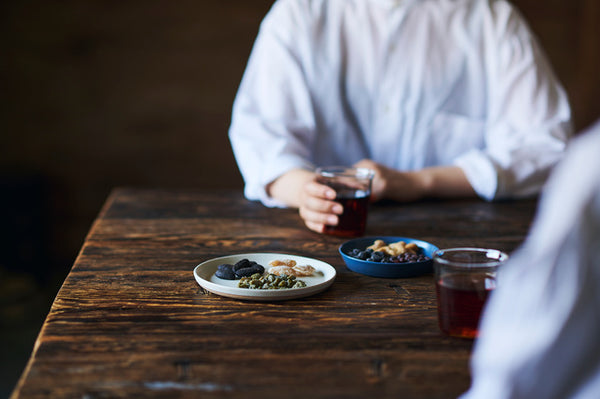
SHUKA is a simple, sophisticated confection made only from seeds and sugar. The packaging, which embodies this world view, omits excessive decoration and consists only of the logo and colors representing each seed. Since "candying" is an ancient food preservation technique, the fact that it can be stored at room temperature without the use of any modern preservatives is another reason we recommend it as a gift or souvenir.


Recipe
The only ingredients are seeds and sugar.
Seeds and sugar only
SHUKA is made using an ancient food preservation technique known as "candying." The only ingredients used are seeds and sugar. We do not use any modern preservatives, nor do we use any artificial coloring or bleaching agents.

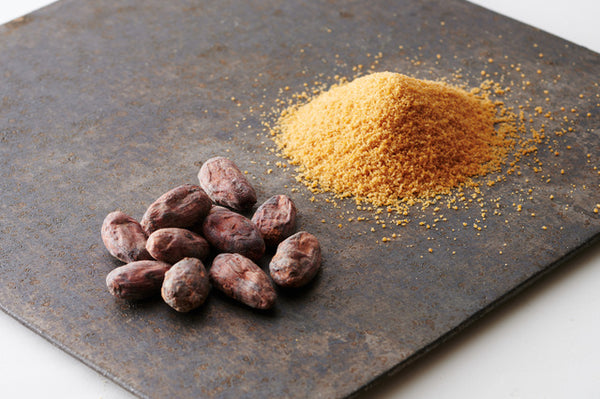
Cacao beans and organic coconut sugar
Preserving the natural texture of the seeds just right.
First, we simmer the ingredients to allow them to absorb moisture. In traditional Japanese confectionery, it is common to simmer them as softly as possible to ensure they melt in the mouth; however, at SHUKA, we use a unique, extensively researched method to retain not only the original shape and color of the seeds but also their texture, resulting in a firm, "al dente" bite.

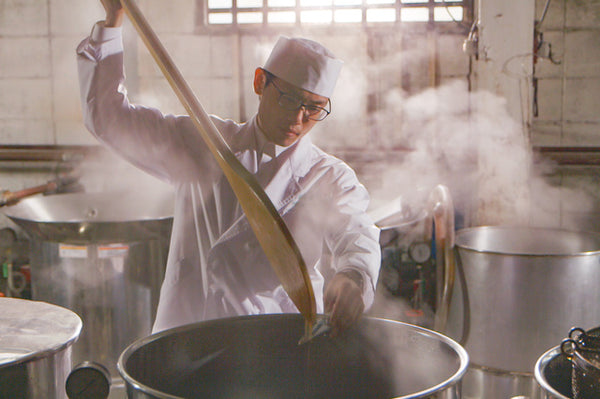
Measuring the sugar content of syrup
Slowly soaked for three days
Next, we make a syrup and soak the ingredients in it. Due to the physical phenomenon known as osmosis, the moisture inside the ingredients is replaced by the sugar in the syrup, causing the sugar to gradually penetrate the material. This process stops once the sugar concentration inside the ingredients balances with the sugar concentration in the external syrup.
By applying this principle, we repeat the process of increasing the syrup's sugar concentration and soaking the ingredients to ensure the sugar permeates to the core. This process takes about three days.

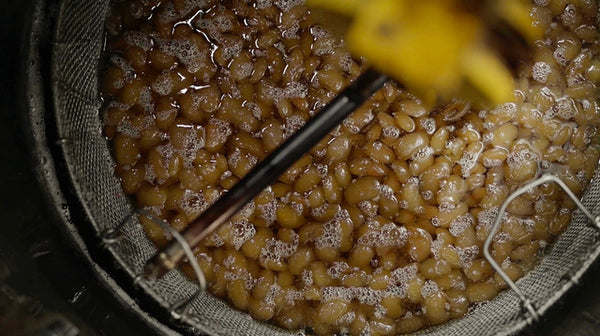
Toroku beans (white runner beans) quietly soaking in syrup
Wasanbon, a sugar unique to Japan
Finally, we let the product sit overnight to dry its surface, which enhances both its ease of eating and its shelf life. For this step, we use Wasanbon, a sugar unique to Japan. This is a traditional product dating back to the Edo period, made from "Chikutou," a domestic variety of sugarcane.
By sprinkling it on just right, we encourage the surface to dry while simultaneously imparting the sugar's gentle flavor. Our craftsmen make fine adjustments to the amount used based on that day's temperature and humidity to achieve the perfect balance.
In this way, it takes about four days from the start of preparation for each piece of SHUKA to be completed.

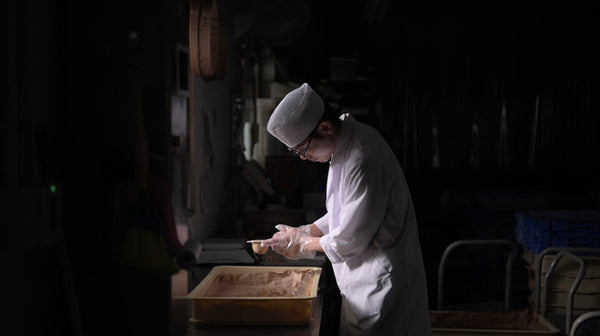
A craftsman sprinkling Wasanbon sugar after draining the syrup.
Grower
Carefully selected ingredients
SHUKA uses only seeds and sugar. Therefore, we carefully select each individual ingredient, using only those of value to be passed down to future generations. Specifically, we make our judgments based on the following three criteria:
1. We know the producers personally
2. There is respect for nature
3. A passion for quality

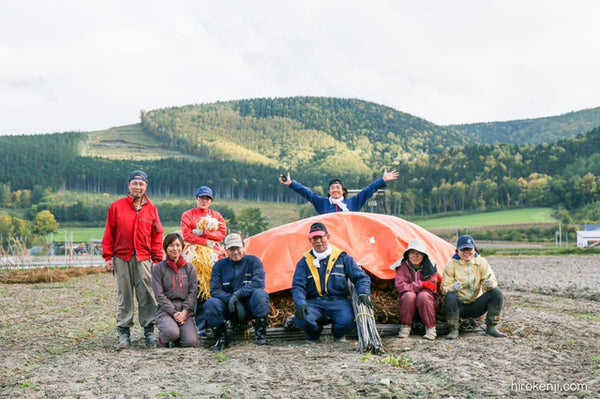
Moriya Farm in Kitami City, Hokkaido, a major production area for runner beans
Story
Story
From "Anything but an amanatto shop"
to "It has to be me"
I was born the eldest son of "Torokuya," a Kyoto-based family business specializing in "amanatto," a traditional Japanese sweet. The shop was founded in 1926 (the first year of the Showa era) by my great-grandmother, Sueno Kondo.
However, I was determined never to become an amanatto maker. When I was in middle school, I was teased for my family's business, with people calling "sweet natto" gross. Being at a sensitive age, I began to feel embarrassed and started hiding the fact that my family ran an amanatto shop.

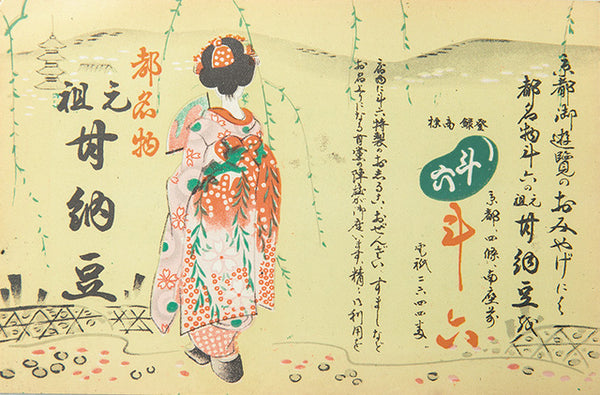
A woodblock print "hikifuda" (equivalent to a modern-day shop card) from the time of the company's founding.
The value of amanatto. A newfound sense of mission.
After graduation, I spent two years working at a large, long-established confectionery shop, where I gained experience with many different Japanese and Western sweets before joining the family business at 26. My first impression of amanatto was that it was "old-fashioned." Compared to Western sweets in particular, it lacked flair, was coated in an overwhelming amount of sugar, and the packaging was nothing more than a generic bag found anywhere else.

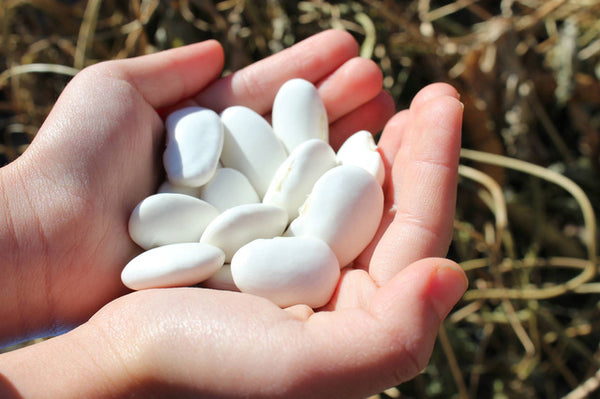
Freshly harvested Toroku beans (white runner beans)
Taking Amanatto to the world
To ensure this continues as a culture, we need to change this image and, in particular, pass it on to the younger generation. Thinking about how to achieve this, I had a vague idea that if we could gain recognition overseas, it might create an impact. I therefore decided to submit our products to the Slow Food international event held in Italy every two years. Slow Food is a grassroots movement originating in Italy that aims to preserve and pass on rich regional food cultures. Local foods from all over the world gather there, and amanatto was a perfect fit.

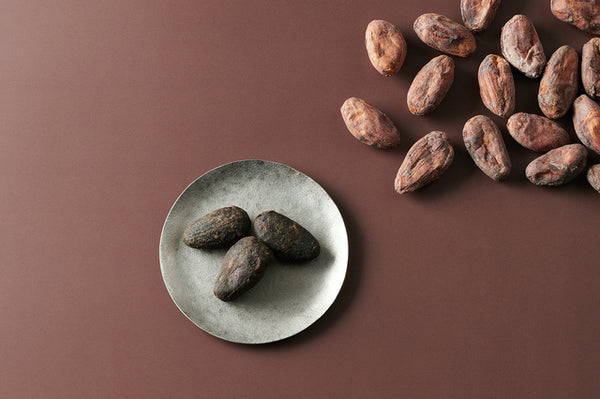
"Cacao Amanatto" (2020), developed with inspiration from chocolate seen in Italy
Build a brand that resonates globally.
So, I consulted with Mr. Masashichi Nakagawa, Chairman of Nakagawa Masashichi Shoten, who is renowned for his work in business revitalization and branding for traditional crafts. He listened to everything—the history of amanatto, the current situation, and my own aspirations.
As we proceeded with the consulting sessions, the vague uncertainties I had been feeling were distilled into a clear concept: "Lending a hand to nature's bounty." Furthermore, inspired by Chairman Nakagawa's remark that "if you break down amanatto, it's just beans and sugar—fundamentally, it's 'seeds' and 'sugar'," we arrived at the brand name "SHUKA," which succinctly expresses this idea.

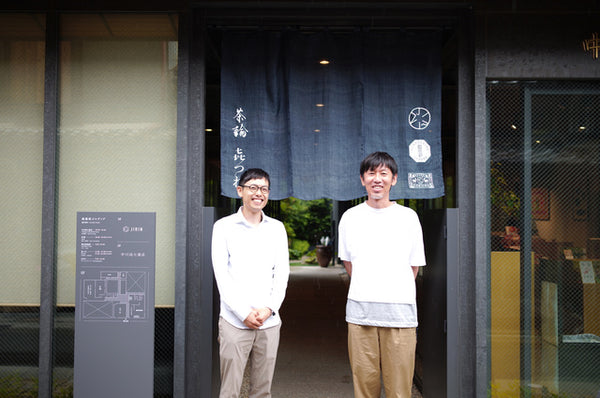
At the Shika Saru Kitsune Building in Nara with Mr. Masashichi Nakagawa